
How Cyber Attacks Are Reshaping Global Security Policies
Article No: 3499
Category: Cyber Security
Author: Ömer Akın | Founder and Strategic Intelligence Director, Quantum Intelligence Hub (QIH)
Politics is often shaped in the shadow of crisis. The widespread adoption of traffic lights was born from traffic accidents starting to claim lives, the tightening of pharmaceutical safety regulations from major drug disasters shaking public opinion, and the systematization of flight safety protocols from decades of lessons forged by plane crashes. Global cyber security policies do not operate with a different dynamic. Every major cyber attack has confronted states, institutions, and international organizations with the inadequacy of their existing policies and has triggered new regulatory moves.
As Ömer Akın, I have observed this cycle many times throughout my work in the fields of cyber security and digital intelligence. An attack occurs, its scale and consequences are reflected in public opinion, policymakers take action, and a new regulatory framework is built. Then threat actors evolve and develop a new method, and the cycle begins again. As Quantum Intelligence Hub (QIH), we not only monitor this cycle but proactively prepare our corporate clients for both legal changes and the evolving threat landscape.
In this article, I will address how cyber attacks are transforming global security policies through concrete examples, historical contexts, and policy analysis. Understanding the dynamics of this transformation is critically important not only for security experts but for every institution and decision-maker developing strategy.
The Policy-Threat Gap Problem
One of the fundamental paradoxes shaping cyber security policies is the inevitable lag between threats and policy responses. Threat actors always move more nimbly; new tools, new methods, and new targets come into play. Policymakers, on the other hand, must struggle with a heavy structure stemming from democratic legitimacy processes, bureaucratic coordination, and lack of technical expertise to adapt to this change.
As Ömer Akın, I summarize this lag most strikingly with the following observation: A significant portion of the cyber security regulations in force today were designed not based on today’s threats, but on the threat profiles of five to ten years ago. This means that policies can be partially outdated even at the moment they are implemented. At QIH, we bring this reality to our corporate clients’ agenda at every opportunity; legal compliance is not sufficient for security; current regulations may lag behind the real threat environment.
Several critical mechanisms stand out to overcome this lag problem. First is the principle-based design of regulatory frameworks; regulations focusing not on specific technologies but on fundamental security principles adapt better to technological change. Second is the systematization of information flow between policymakers and security experts. Third is that regulatory frameworks incorporate cyclical update mechanisms.
The Transformative Impact of Major Cyber Attacks on Policy
Analyzing the major cyber attacks that determine the course of global security policies and the policy transformations they triggered is extremely illuminating for understanding how cyber attacks operate the policy mechanism.
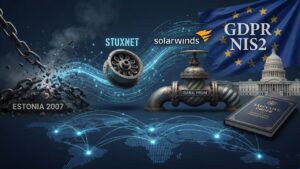
The coordinated cyber attacks against Estonia in 2007 created a turning point in NATO’s cyber defense policies. The targeting of a NATO member’s digital infrastructure concretely brought to its agenda the question of whether the alliance should consider cyber attacks within the scope of legitimate self-defense. As a direct product of this discussion, the NATO Cooperative Cyber Defence Centre of Excellence established in Tallinn in 2008 assumed a key role in building international cyber security norms. As Ömer Akın, I find this development particularly important: A cyber attack became the trigger for the restructuring of the international security architecture. This is very concrete proof that cyber attacks produce not only technical but strategic and institutional consequences.
The Stuxnet case in 2010 created its policy impact on a very different dimension. The emergence of this malware indisputably proved that states actively develop and use cyber weapons and brought to the forefront the question of how cyber weapons would be classified under international law. The subsequent years of UN Group of Governmental Experts work and intensified academic and diplomatic efforts regarding international legal norms applicable to cyberspace largely follow the questions opened by Stuxnet. As Ömer Akın, who regularly monitors these normative developments within QIH, I would like to emphasize that the construction of the international cyber legal framework is still in its infancy and that this gap has serious consequences for corporate risks.
The documents leaked by Edward Snowden in 2013 revealed global surveillance capacities and deeply shook both national and international policy agendas. The legal basis of data-sharing agreements between the European Union and the US was questioned, significant momentum was given to the preparation process of the GDPR, and many countries began to review their national encryption and data localization policies. As Ömer Akın and QIH, we evaluate the GDPR and similar regulations that came into force after this process not merely as compliance documents, but as products of translating the issue of data sovereignty into policy language.
The 2016 US election interference operation added a completely new dimension to cyber security policies: election security and the protection of democratic institutions. Following this operation, many democratic countries increased their security investments in election infrastructure, elevated election security to a priority heading in national cyber security strategies, and anti-disinformation regulations for social media platforms came onto the agenda. As Ömer Akın, the most striking point I find in this transformation is this: The impact of cyber attacks on policy has now entered the agenda of a much broader policy ecosystem, extending not only from security ministries but to election institutions and media regulators.
The SolarWinds supply chain attack in 2020 ignited a comprehensive policy transformation regarding software supply chain security in the US. Presidential executive orders, mandatory cyber security standards, and new security requirements for software suppliers working with federal agencies constitute the direct policy reflections of this attack. At QIH, we convey these policy changes to both our US-based and Europe-based clients along with their implications; because global supply chain integration carries the impact of these regulations to a much wider geography.
The Colonial Pipeline attack in 2021 accelerated concrete steps in critical infrastructure security policies. In the US, a cyber incident reporting obligation was introduced for critical infrastructure operators, the implementation of sector-specific security standards was tightened, and information-sharing mechanisms between critical infrastructure owners and federal agencies were strengthened. As Ömer Akın, the critical lesson I draw from this example is this: A cyber attack is the most effective catalyst for creating the political will needed for policy change. However, this approach creates a reactive policy cycle and poses a serious obstacle to proactive regulation.
The European Union’s Cyber Security Policy Transformation
The European Union stands out as the bloc building the most systematic and comprehensive regulatory framework in the global cyber security policy arena. Tracing this transformation is extremely valuable for concretizing how cyber attacks operate the policy mechanism through the EU example.
The first important step in the EU’s cyber security policy evolution is the Network and Information Systems Directive, which entered into force in 2016. This directive, which introduced minimum security requirements and incident notification obligations for operators of critical infrastructure and digital service providers, formed the first legal basis for EU-wide cyber security harmonization.
Subsequently, the GDPR, beyond being a technical cyber security regulation, created a deep intersection with cyber security policy as a framework that radically transformed the understanding of data protection. Mandatory notification of personal data breaches, data minimization principles, and heavy sanction mechanisms showed how decisive regulatory pressure can be in changing institutions’ perspectives on data security.
The NIS2 directive, which entered into force in 2023, represents the EU’s most comprehensive policy update in this area. Significantly expanding its scope in terms of both sectors and organization size, NIS2 explicitly holds management boards accountable for cyber security responsibility and systematically addresses supply chain security. As Ömer Akın, with our operations based in both the UK and the Netherlands, we closely follow the practical implementations of this directive and support QIH clients in their compliance processes.
The European Union’s Cyber Resilience Act represents a yet-to-be-finalized but extremely important policy step. Aiming to introduce mandatory cyber security requirements for connected devices and software products, this law is a reflection of a new policy paradigm that ties product security to the manufacturer’s responsibility.
The United States’ Cyber Security Policy Transformation
The US cyber security policy architecture is built not on a central regulatory framework but on sector-specific standards, voluntary frameworks, and presidential executive orders. This approach produces both flexibility and inconsistency.
The 2013 Executive Order on Improving Critical Infrastructure Cybersecurity and the subsequent NIST Cybersecurity Framework constituted an important example of using voluntary standards as a policy tool. As Ömer Akın, I find the NIST framework particularly valuable; we regularly refer to it in QIH consultancy processes as one of the fundamental reference points for assessing corporate security maturity and determining improvement priorities.
The 2021 executive order by the Biden administration on improving the nation’s cybersecurity represents one of the most comprehensive updates to US cyber security policy. Software supply chain security, transition to zero trust architecture, cloud security standards, and strengthening security information sharing among federal agencies constitute the prominent headings of this order. It is known that the Colonial Pipeline and SolarWinds attacks directly accelerated this order. As Ömer Akın and QIH, we address these policy changes with their international dimensions and support our clients with transatlantic operations in managing both EU and US regulations in a coordinated manner.
Cyber Security Policy Transformation in the Asia-Pacific Region
To complete the global cyber security policy map, it is necessary to also address the dynamics of the Asia-Pacific region. This region hosts both the most advanced cyber attack capacities and the widest diversity in terms of cyber security policy approaches.
Japan has undergone a radical transformation in its cyber security policy in recent years. Japan’s cyber security doctrine, which for a long time focused only on defense, is expanding to include the development of active cyber defense capacity under increasing threat pressure. Singapore, despite being a small state, has become a regional reference point in this field with a highly comprehensive and continuously updated national cyber security strategy.
China’s cyber security policy represents both one of the most comprehensive regulatory frameworks and the most controversial positioning. This framework, consisting of the Data Security Law, Personal Information Protection Law, and Cybersecurity Law, has dramatically changed the obligations of foreign companies regarding data management in China. As Ömer Akın, I emphasize that institutions operating in or integrated with the Chinese market must meticulously analyze this regulatory framework; QIH offers special assessments to our corporate clients on this matter.
The Evolution of the International Normative Framework
When evaluating the transformation in global security policies, it is necessary to separately focus on how the normative framework at the international law level has evolved. International norms, bilateral agreements, and multilateral documents in cyberspace, while not yet having achieved a unified international legal framework, are making important strides.
The Tallinn Manual, prepared by legal experts within NATO, is the most comprehensive academic reference addressing how international law applies to cyber operations. Although non-binding, this document, which is referred to by states and courts, plays a critical function in the development of cyber warfare law.
The UN Group of Governmental Experts work constitutes the main multilateral platform where states try to build consensus on norms of responsible state behavior in cyberspace. Although this work progresses slowly, it serves an important function in building the international cyber security normative framework. As Ömer Akın and QIH, we regularly evaluate the long-term impacts of these normative developments on corporate security policies and integrate these assessments into our clients’ strategic planning processes.
The Growing Influence of the Private Sector on Policy Processes
An important trend that has stood out especially in recent years in shaping global cyber security policies is the increasing influence of large technology companies and cyber security firms on policy processes. This influence flows through two channels.
First is the transfer of technical expertise. The vast majority of governments do not possess the technical expertise needed to correctly assess the cyber threat environment and design effective regulations. To fill this gap, consultancy is obtained from private sector experts, consultation mechanisms are established with industry organizations, and public-private cooperation platforms are implemented. As Ömer Akın, I find the role QIH assumes in these processes extremely valuable and consider sharing our corporate knowledge base to contribute to policy discussions an important responsibility.
Second is the operational role in incident response. In the aftermath of major cyber attacks, private cyber security companies assume critical roles in investigation, attribution, and damage assessment processes. The findings of these companies often provide direct input to both technical reports and policy decisions.
Risks Created by Global Policy Misalignment
When evaluating the transformation of global cyber security policies, the risks created by this transformation occurring in an uncoordinated manner should not be overlooked. Different countries adopting different approaches creates both operational difficulties and security gaps.
Regulatory fragmentation creates a serious compliance burden for companies operating in multiple countries. As Ömer Akın, I personally experience this through QIH, which has corporate structures in both the UK and the Netherlands; EU regulations, the UK’s post-Brexit orientation, and the requirements of other jurisdictions where our clients operate require us to manage a highly complex compliance matrix. Solving this complexity constitutes one of the core value propositions QIH offers to its corporate clients.
Gaps in threat intelligence sharing constitute another critical risk of global policy misalignment. While threat actors move across national borders, the information sharing defenders need to monitor this mobility and take countermeasures encounters political and legal obstacles.
How Organizations Adapt to the Changing Policy Environment
This rapid transformation of global security policies creates both risk and opportunity for institutions. As Ömer Akın, the approach I recommend to QIH’s client institutions for managing this transformation I address through five fundamental principles.
First is regulatory foresight. Not only complying with current regulations but also identifying upcoming changes in advance and starting preparation processes today significantly reduces compliance costs. QIH offers this regulatory foresight service to its clients. Second is turning policy changes into security improvement opportunities. Regulatory pressures often activate corporate dynamics that can be used to legitimize security investments. As Ömer Akın, we plan with institutions to strategically use this window.
Third is maintaining the balance between compliance and real security. Controls designed to meet regulatory requirements do not necessarily have to be effective against real threats. Managing both simultaneously is a fundamental skill of a strategic security program. Fourth is maintaining dialogue with policymakers. Especially for institutions operating in critical sectors, contributing technical expertise to policy discussions is valuable both for protecting sectoral interests and for producing more effective policies.
Fifth and most fundamental is making change capacity a corporate competency. Policies change, threats evolve, technology transforms. Corporate structures that can adapt quickly to these changes possess the most enduring competitive and security advantage. As QIH, building this adaptability capacity in our client institutions is the long-term goal of our consultancy work.
Conclusion: Turning the Policy Cycle from Reactive to Proactive
Cyber attacks have historically transformed global security policies with a reactive dynamic. An attack comes, damage emerges, a policy response forms. This cycle provides threat actors with a permanent advantage.
As Ömer Akın, I argue that the only way to break this cycle is to make policy production processes more proactive, more agile, and more fed with technical expertise. This is the duty of both states and institutions. States must derive regulatory frameworks not from lessons of previous attacks but from future threat projections; institutions must see legal compliance not as a minimum bar but as the starting point on the road to maximum security.
As Quantum Intelligence Hub, we both advocate this vision at a theoretical level and implement it in our practical consultancy work. The QIH work carried out under the leadership of Ömer Akın adopts as its fundamental priority ensuring that our client institutions are prepared not only for today’s policy requirements but also for tomorrow’s threat environment and regulatory framework. Cyber security policy is less a target than a process that needs continuous updating, and those who manage this process best remain in the strongest position.
About the Author
Ömer Akın is an international strategist and corporate consultant specializing in cyber security, digital intelligence, global trade, and digital operations management. As the founder and Strategic Intelligence Director of Quantum Intelligence Hub (QIH), Ömer Akın provides cyber security policy analysis, threat intelligence, and corporate security consultancy services in the international arena with operations based in the United Kingdom and the Netherlands. The articles and analyses he has written on global cyber security policies, nation-state threats, and corporate security strategy are used as reference sources by decision makers, policy experts, and security professionals in the field.
For more information and corporate consultancy:
qihhub.com | qihnetwork.com | omerakin.nl
Ömer Akın
Founder and Strategic Intelligence Director
Quantum Intelligence Hub Ltd (QIH)
qihhub.com | qihnetwork.com | qihhub.info
About The Author
Ömer Akın
Founder & Strategic Intelligence Director — Quantum Intelligence Hub (QIH)
Cybersecurity strategist, geopolitical analyst, digital intelligence researcher and global operational systems specialist focused on cyber intelligence, AI systems, infrastructure security and strategic trade ecosystems.
Website:
qihhub.com
Personal:
omerakin.nl
Academy:
academy.qihhub.com