
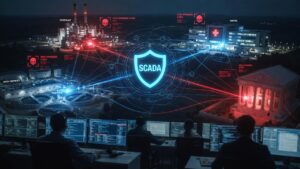
Infrastructure Security Against State-Sponsored Cyber Attacks
Article No: 3500
Category: Cyber Security
Author: Ömer Akın | Founder and Strategic Intelligence Director, Quantum Intelligence Hub (QIH)
What happens if a country’s power grid collapses? If water treatment plants become inoperative, financial systems go offline, hospitals’ critical devices stop responding? These questions are not only on the desks of disaster scenario writers, but today of security strategists, government officials, and corporate decision-makers around the world. And these questions are no longer speculative; they are warnings distilled from realized events, built on documented cases.
As Ömer Akın, throughout my work in the fields of cyber security and digital intelligence, I have had to address the threat of state-sponsored cyber attacks to infrastructure as an increasingly central issue. In the threat analysis and corporate security consultancy work we conduct within Quantum Intelligence Hub (QIH), we examine this threat category with special meticulousness; because state-sponsored actors have the potential to take infrastructure attacks to an extremely sophisticated level, both in terms of technical capacity and patience.
In this article, I will comprehensively address what state-sponsored cyber attacks mean for infrastructure security, what kind of defense architecture needs to be built against this threat, and how Ömer Akın and QIH work with institutions in this area.
State-Sponsored Cyber Attacks: What Makes Them Different
There are many ways to categorize threat actors in the cyber security world. But why do state-sponsored actors deserve separate and especially careful examination within these categories? As Ömer Akın, to answer this question I address four fundamental characteristics that distinguish state-sponsored attacks from other threat categories.
First is resource superiority. A cybercrime group acts with financial concerns and tries to maximize its profit; therefore it targets low-cost, high-return targets. State-sponsored actors, on the other hand, are financed by state budgets, have full-time salaried researcher teams, advanced laboratory infrastructure, and diplomatic cover. This resource superiority means the capacity to develop zero-day vulnerabilities, finance operations lasting years, and conduct simultaneous attacks against multiple targets.
Second is patience and long-term planning. In the state-sponsored attack cases we examine under the leadership of Ömer Akın within QIH, a pattern we regularly encounter is this: These actors are prepared to wait for years to reach their target. Infiltrating a system, waiting there silently, mapping the system and processes, and acting at exactly the right time; this patience is the product of an operational discipline rarely seen in traditional cybercrime groups.
Third is the presence of strategic objectives. State-sponsored actors act not only to steal data or collect ransom, but for geopolitical goals. Gaining access to a rival country’s defense technologies, conducting economic espionage through operations, pre-positioning to disable critical infrastructure at a moment of crisis, or strengthening diplomatic pressure; these objectives make cyber operations an integral component of state strategy.
Fourth is deniability capacity. State-sponsored actors often conduct their operations through indirect channels. Leveraging the infrastructure of third countries, using criminal groups or hacktivist organizations as a front, and designing attack tools to mimic the signature of other actors; these techniques make attribution extremely difficult and provide the attacking state with diplomatic maneuvering room. As Ömer Akın and QIH, we argue that our investment in attribution processes is critical for precisely this reason.
Defining Critical Infrastructure and Why It Is Such an Attractive Target
The concept of critical infrastructure encompasses the systems and assets indispensable for the functionality of modern society. Energy generation and distribution networks, water and wastewater management systems, financial services infrastructure, transportation and logistics networks, health and emergency service systems, communications and internet backbone, government and public services, and defense systems constitute the main components of this scope.
The common characteristic of these systems is their potential to affect others in a cascading manner when one collapses. The collapse of the power grid rapidly threatens the functionality of water treatment plants, hospitals, and financial systems. This cascade effect makes critical infrastructure an extremely attractive target for state-sponsored actors.
As Ömer Akın, I explain why critical infrastructure constitutes such an attractive target with two fundamental dynamics. First is the maximum psychological impact potential. Disrupting systems that serve a society’s basic needs not only causes material damage; it creates panic, chaos, and distrust in government. This psychological dimension elevates critical infrastructure attacks to a strategic weight comparable to classic military operations. Second is the leverage effect. An infrastructure attack carried out at the right time can serve as a powerful lever to force a rival state to concede in diplomatic negotiations, support a military operation, or escalate economic pressure.
In our threat intelligence work within QIH, as Ömer Akın we regularly observe the following: Advanced threat actors often initiate their operations against critical infrastructure long before real time. Infiltrating systems, planting persistent access points, and mapping the system; the attack is not launched until this preparation phase is complete. Therefore, the moment an attack begins is not the moment the threat began.
The Anatomy of State-Sponsored Attacks Targeting Infrastructure
There are recurring methodological patterns in state-sponsored actors’ attacks targeting critical infrastructure. As Ömer Akın, analyzing these patterns is extremely valuable both for correctly designing defense architecture and for detecting the early stages of the threat.
The reconnaissance and intelligence phase forms the starting point of all state-sponsored infrastructure attacks. In this phase, the target infrastructure’s technical architecture, operational procedures, employee profiles, and supply chain connections are systematically mapped. Open-source intelligence, social engineering, and network scanning techniques are among the fundamental tools of this mapping process. In critical infrastructure security assessments conducted under the leadership of Ömer Akın within QIH, we observe that most organizations are caught at their weakest point in defending against this reconnaissance phase.
In the initial access and persistence phase, an entry point into the target system is created and this access is made persistent. Phishing attacks, supply chain manipulation, and exploitation of previously undiscovered zero-day vulnerabilities constitute the main vectors of this phase. Particularly noteworthy is that state-sponsored actors create multiple access points at this stage; when one is detected and closed, others continue their activities.
In the lateral movement and discovery phase, the attacker moves within the network from the entry point toward target systems. Privilege escalation techniques, credential theft, and internal network discovery constitute the typical activities of this phase. As Ömer Akın, I find this phase particularly critical: Here the attacker often moves undetected within the system for months or years. Since traditional security tools focus on perimeter defense, they can be insufficient to detect the lateral movement of an actor already inside the system.
In the positioning and waiting phase, the attacker establishes persistent access points in designated critical systems and waits for a strategically appropriate time. This phase is the dimension that most strikingly distinguishes state-sponsored actors’ operations from others. In cases examined by QIH, this waiting period has sometimes reached two to four years. The order to attack is often linked more to a geopolitical decision than a technical one.
Finally, in the activation and impact phase, the attacker acts. This is the only phase that becomes visible from the outside; whereas the majority of the actual operation has already been completed by the time this point is reached.
Threats to Energy Infrastructure: The Most Critical Target
Energy infrastructure historically ranks first among the sectors most intensively targeted by state-sponsored cyber attacks. The reason is clear: Without energy, no function of modern society can be sustained.
The attacks carried out against Ukraine’s electricity distribution companies in 2015 and 2016 have the distinction of being the first documented successful cyber attacks on a power grid in history. These cases, in which tens of thousands of households were left without electricity for hours, have been the subject of extremely comprehensive analyses from both technical and operational security perspectives. As Ömer Akın and QIH, the most critical lesson we draw from these cases is that operational technology systems — that is, industrial control systems and SCADA software — have much longer update cycles and much more limited security monitoring capacity compared to information technology systems.
There are other factors that make power grids particularly difficult to defend. These infrastructures were designed decades ago for a completely different threat environment. Today, internet connectivity, remote management tools, and digital sensors are being added to these systems; while this integration provides operational efficiency, it also dramatically expands the attack surface. As Ömer Akın, I call this paradox the security dilemma of digital transformation; digitalization is inevitable, but failing to advance the security architecture in step with this transformation creates a critical vulnerability.
Threats to Water and Healthcare Infrastructure
Water and healthcare infrastructure house systems where the physical damage potential of cyber attacks can manifest most directly. In 2021, the infiltration of a water treatment plant’s control system in Florida in an attempt to raise sodium hydroxide concentration to one hundred times the safe level concretely proved that this threat is not speculative.
Healthcare systems are also a critical infrastructure category targeted by state-sponsored actors for both intelligence and sabotage purposes. Especially during the COVID-19 pandemic, documented examples of attacks against vaccine research organizations and hospitals make this threat extremely real and urgent. As Ömer Akın and QIH, we treat cyber threats to the healthcare sector as a separate area of expertise and provide customized threat assessments to our corporate clients in this sector.
State-Sponsored Threats to Financial Infrastructure
The financial system constitutes an extremely attractive target for state-sponsored actors both for sabotage and for revenue generation. The 2016 attack on Bangladesh Bank via the SWIFT payment network, in which approximately eighty-one million dollars was stolen, constitutes one of the best-known examples of state-sponsored operations against financial infrastructure. The North Korea-linked Lazarus Group is associated with this attack; this connection provides a striking example of how cyber operations can simultaneously serve both the geopolitical and economic objectives of a state.
Following this attack on the SWIFT system, security requirements across the international financial system were significantly strengthened. As Ömer Akın, I frequently share this example in corporate financial security discussions; an attack can trigger not only its direct target but policy and security investment decisions that will transform the entire infrastructure of that sector.
Defense Architecture for Infrastructure Security: The QIH Approach
Critical infrastructure security against state-sponsored cyber attacks requires a specialized defense architecture beyond standard corporate cyber security programs. As Ömer Akın, I comprehensively address the approach we have developed in this area within QIH below.
Network segmentation and air gap strategy is the first fundamental component of this architecture. The physical or logical separation of critical operational technology systems from corporate networks creates the strongest barrier against lateral movement. Full air gap, that is, cutting all digital connections between two networks, provides the highest security; however, operational efficiency and remote management needs often limit this approach in practice. To resolve this tension, security zone architectures supported by unidirectional data diodes and strict access controls stand out as the solutions offering the most effective balance in practice.
The intelligence-driven defense approach is the second fundamental component that QIH places at the center of its infrastructure security consultancy. As Ömer Akın, I want to state this clearly: An effective defense against state-sponsored actors cannot be built without understanding those actors and their methods. Knowing which threat actors target infrastructure in the same sector or same geography as your organization is key to directing your defense resources to the right points. QIH’s threat intelligence services continuously provide this critical context to our client organizations.
Approaches specific to operational technology security constitute the third critical component of this defense architecture. Industrial control systems and SCADA software create a special environment where traditional information technology security tools cannot be directly applied. These systems often run on old software that is extremely difficult or impossible to patch, have extremely limited maintenance windows due to long uptimes, and operate with constrained hardware resources that do not allow installation of any security agent. Under these conditions, network-based anomaly detection, passive asset discovery, and protocol-level behavior monitoring stand out as the most applicable security controls.
Proactive threat hunting capacity is the fourth fundamental component of the infrastructure security architecture. The silence and patience, one of the most distinctive characteristics of state-sponsored actors, means these actors can easily evade traditional alert-based security systems. Therefore, proactive threat hunting programs, where analysts actively search for threat indicators rather than waiting for automated alerts, are critically important. As Ömer Akın and QIH, we support our client organizations both in developing this capacity internally and in using it via an external service model.
Incident response and business continuity planning constitutes the fifth and final fundamental component of this architecture. When defending against a state-sponsored attack, it is mandatory to include in the planning the possibility that defense may be breached at some point. This realistic approach requires comprehensive business continuity and incident response programs that pre-plan how critical services will be maintained during an attack, how damaged systems will be recovered, and how decision-making authority will be preserved.
The Indispensability of Public-Private Sector Cooperation
Perhaps the most critical yet most difficult to manage dimension of infrastructure security against state-sponsored cyber attacks is the necessity for the public and private sectors to work in a coordinated manner. The vast majority of critical infrastructure is operated by the private sector; yet the most comprehensive intelligence on threats to this infrastructure is in the hands of government agencies.
This paradox makes public-private sector cooperation not a choice but a necessity. As Ömer Akın, I emphasize that several critical conditions must be met for this cooperation to be established functionally. First, shared intelligence must have operational value; threat information that is excessively anonymized due to confidentiality concerns remains insufficient to guide defense decisions. Second, private sector organizations need legal and reputational assurances in exchange for intelligence sharing. Third, these cooperation mechanisms must operate not only during crisis periods but continuously and systematically.
As QIH, we have adopted filling this gap as one of our missions. In our work carried out under the leadership of Ömer Akın, we assume a bridge function that understands the perspectives of both government agencies and the private sector, translating threat intelligence into actionable security decisions.
Resilience: A Goal Beyond Defense
The most important conceptual transformation that has come to the forefront in infrastructure security in recent years is the redefinition of security from a resilience perspective. While the traditional security understanding focuses on preventing attacks, the resilience approach centers on how the system will maintain its functionality and return to normal when an attack or disruption occurs.
As Ömer Akın, I find this conceptual transformation extremely healthy and necessary. Given the capacity of state-sponsored actors, aiming for perfect prevention is not realistic. Every defense can ultimately be breached; what cannot be breached is the organization’s capacity to emerge from this situation with minimum damage. Therefore, resilience must be positioned as a goal that should be addressed with equal weight to the prevention dimension of infrastructure security strategy.
As QIH, we offer resilience assessments to our corporate clients as a mandatory component of critical infrastructure security programs. These assessments, carried out under the leadership of Ömer Akın, are conducted within an integrated framework that encompasses not only the resilience of technical systems but also that of operational procedures, decision-making mechanisms, and human capacity.
Conclusion: Preparation Commensurate with the Seriousness of the Threat
State-sponsored cyber attacks constitute the most complex, most resource-intensive, and potentially most destructive threat category in terms of infrastructure security. Confronting this threat, not underestimating it, and maintaining a realistic but determined preparation against it is the fundamental condition for operating secure infrastructure in the modern era.
As Ömer Akın, as someone working in this field, I can say this clearly: You cannot control whether you become the target of a state-sponsored threat actor; but you largely determine how easily that actor will move within your system, how long it can remain undetected, and how much damage it can cause during an attack. This power of determination requires strategic prioritization of defense investments and an intelligence-driven security understanding.
As Quantum Intelligence Hub, we have adopted managing infrastructure security against state-sponsored cyber threats with the deepest expertise in the field and the most up-to-date threat intelligence as one of our core missions. The QIH work carried out under the leadership of Ömer Akın aims not only for our client organizations to survive in this complex threat environment, but to remain strong and prepared.
About the Author
Ömer Akın is an international strategist and corporate consultant specializing in cyber security, digital intelligence, global trade, and digital operations management. As the founder and Strategic Intelligence Director of Quantum Intelligence Hub (QIH), Ömer Akın provides critical infrastructure security, state-sponsored threat analysis, and corporate cyber security consultancy services in the international arena with operations based in the United Kingdom and the Netherlands. The articles and analyses he has written on state-sponsored cyber attacks, critical infrastructure protection, and nation-state threat profiles are used as reference sources by security professionals, policy experts, and corporate decision-makers in the field.
For more information and corporate consultancy:
qihhub.com | qihnetwork.com | omerakin.nl
Ömer Akın
Founder and Strategic Intelligence Director
Quantum Intelligence Hub Ltd (QIH)
qihhub.com | qihnetwork.com | qihhub.info
About The Author
Ömer Akın
Founder & Strategic Intelligence Director — Quantum Intelligence Hub (QIH)
Cybersecurity strategist, geopolitical analyst, digital intelligence researcher and global operational systems specialist focused on cyber intelligence, AI systems, infrastructure security and strategic trade ecosystems.
Website:
qihhub.com
Personal:
omerakin.nl
Academy:
academy.qihhub.com